Azumi Kawahara brings a rare kind of rigor to the study of Japanese SM — blending archival history, literary close reading, intellectual history, and hard-nosed source criticism, and steering clear of both knee-jerk pathologizing and cozy community myth-making.
Azumi Kawahara (河原梓水) is a Japanese scholar whose work has been decisive in moving sadomasochism, postwar SM magazines, kinbaku, and historical forms of “perverse sexuality” into a serious academic frame.
An associate professor at Fukuoka Women’s University with a PhD in Literature from Ritsumeikan University, Kawahara was trained in Japanese history — specifically Emishi studies and the ancient state — but her current work lives in the intellectual, cultural, and media history of postwar Japan.
Her contribution isn’t just “legitimizing” SM as a research subject. It’s showing that its discourses, pulp fictions, magazines, reader letters, memoirs, and commercial circuits let you interrogate the big fault lines of modernity: autonomy, consent, equality, violence, democracy, nationalism, censorship, the archive, and how communities form.
This piece opens with her professional profile, then digs into the interpretive core of her work.
The central thesis is this: Kawahara brings to Japanese SM studies a rigor that fuses documentary history, literary analysis, history of ideas, and source criticism — dodging both lazy pathologization and uncritical community hagiography.
A historian in an uncomfortable field
Azumi Kawahara is currently an associate professor at Fukuoka Women’s University. Her official ResearchMap profile lists her as associate professor, with a doctorate in Literature from Ritsumeikan University, awarded in September 2012. The same record notes her time at Ritsumeikan’s Graduate School of Letters, postdoctoral research, a visiting fellowship at Freie Universität Berlin, and her appointment at Fukuoka Women’s University — assistant professor from April 2020, associate professor from April 2023.
What matters here isn’t a laundry list of titles. It’s the intellectual position that trajectory makes possible. Kawahara comes out of solid Japanese historical training. Her doctoral thesis sits in ancient history, focused on the Japanese state order and the Emishi under the Ritsuryō system.
That background matters, because her later work on SM, sexuality, and postwar culture keeps a distinctly historian’s set of worries: what counts as a source, how to tell testimony apart from evidence, how chronology gets built, how genealogies are constructed, and how to push back against retrospective storytelling.
Unlike approaches that flatten sadomasochism into individual psychology, sexual deviance, cultural exoticism, or erotic subculture, Kawahara treats it as a problem in intellectual history.
Her academic profile lists two key books: SMの思想史 : 戦後日本における支配と暴力をめぐる夢と欲望SM no shisōshi: Sengo Nihon ni okeru shihai to bōryoku o meguru yume to yokubō — in English, An Intellectual History of SM: Dreams and Desires around Domination and Violence in Postwar Japan — published by Seikyūsha in May 2024, and Achieving Madness: For the Affirmation of “Stupid,” “Perverse” and “Valueless” Lives, co-edited with Mariko Konishi in 2022.
Those titles signal a conceptual shift: the object isn’t just “SM” as a practice, but the possibility of thinking lives, desires, and discourses that were branded stupid, perverse, useless, or worthless.
Kawahara’s work thus sits in a doubly difficult space. On one side, she handles materials long dismissed as pornographic, marginal, shameful, or not worth preserving. On the other, she works on communities that have often built their own historical memory through insider stories, lineages, anecdotes, master memoirs, fanzines, and later translations.
Her scholarly intervention isn’t to throw out those memories. It’s to read them with the tools of historical criticism.
That mix — closeness to a marginal archive, and critical distance from inherited narrative — is a big part of why Kawahara has become central to the study of postwar Japanese SM, magazines like Kitan Club, erotic literature, debates over “perversion,” kinbaku, and modern discourses of consent, violence, gender, and desire.
The interpretive core of her work: from marginal object to historical problem
De-pathologizing isn’t the same as idealizing
One key to Kawahara’s work is her flat refusal to let SM be studied only as pathology. She’s interested in how sadism, masochism, fetishism, homosexuality, cross-dressing, and other desires were modernly classified as “abnormal,” “sick,” or dangerous. But she doesn’t stop at calling out that labeling.
Her question cuts deeper: what kinds of thinking, writing, community, and ethics actually took shape right in the margins of that pathologization?
That distinction is everything.
Taking the pathology label off an object is not the same as giving it a free pass. Kawahara doesn’t turn SM into some pure, emancipatory, automatically subversive zone. In fact, her research notes name hard problems head-on: violence, misogyny, consent, fantasy, the market, regulation, censorship, and inequality.
What her work rejects is the move that shuts down thinking before it starts: the idea that certain desires, because they were once tagged perverse or ridiculous, don’t deserve an intellectual history.
In that sense, her research doesn’t just ask “what is SM?” It asks what SM reveals about the society that calls it abnormal.
Fantasies of domination and submission, stories of pain and pleasure, reader letters, erotic confessions, and postwar fictions become pressure points where central categories of modernity get stretched to the breaking point: the autonomous subject, consent, equality between men and women, companionate marriage, citizenship, democracy, legitimate violence, and respectable life.
The point isn’t to swap condemnation for cheerleading. It’s to produce knowledge right where the dominant culture put silence, shame, or caricature.
Magazines as archive: Kitan Club and the historical value of the ephemeral
The second pillar of Kawahara’s work is a close focus on the print archive — especially postwar SM magazines like Kitan Club, Ningen Tankyū, Amatoria, Fūzoku Sōshi, and Fūzoku Kagaku.
What makes this body of work matter is that these aren’t just porn rags. They’re spaces for writing, reading, exchange, classification, imitation, argument, and identity-building.
In the available summary of SM no shisōshi, Kitan Club shows up as a hub that brought together people interested in sadism, masochism, fetishism, homosexuality, and cross-dressing — long better known for its underground mystique than for systematic study of what was actually inside it.
Kawahara closes that gap with source work: she goes through issues, editorial genealogies, copycat titles, authors, pen names, letters, and reader participation.
That changes the status of the magazine. A publication you could once write off as sensationalist starts working as a historical archive. You don’t just find fiction and images. You find traces of cultural circulation: who wrote, who read, what you could say, what got censored, what vocabulary let people talk about desire, what forms of anonymity were used, how readers connected with editors, and how the lines between fantasy, confession, and everyday life were negotiated.
The magazine becomes a document of belonging — not because it transparently tells “the truth” about a community, but because it records historically specific ways of speaking when other venues simply weren’t available.
In a context where many minority experiences left no institutional paper trail, niche magazines and their letters pages can hold irreplaceable material.
Kawahara doesn’t treat that material as straight testimony. Confessions published in Kitan Club are laced with fiction, stylization, editorial fantasy, and porn conventions. Precisely because of that, they’re historically dense. They don’t just document “what happened.” They document what could be imagined, written, desired, and shared under specific cultural conditions.
Confession, fiction, and “life records”
A particularly productive thread in Kawahara’s research is her reading of confessional texts.
In “The Life Recording Movement of Sexuality: The Relationship between Perverse Desire and Modern Marriage Life,” published in Antitled in 2022, Kawahara explores the relationship between desire labeled perverse and modern married life.
What makes this line of work stand out is that sexual confession isn’t read as porn, full stop. Kawahara links it to broader traditions of life writing.
The “life record movement” (seikatsu kiroku undō) gave ordinary people a framework to narrate their experiences, conflicts, and relationship to modern life. When that impulse moves into the territory of so-called deviant sexuality, SM magazine confessions take on an unexpected dimension: they’re texts where “perversion” gets narrated from the inside, in the first person, and tied to everyday life, marriage, gender, and social morality.
That forces you to read carefully. A confession in an erotic magazine can be fantasy and product and textual performance and a bid for recognition and a historical document — all at once.
Its value doesn’t hinge on it being “true” in some naïve sense. It hinges on showing how subject positions were produced. Put another way: it lets you study how someone could say “I” from a desire socially marked as abnormal.
That’s one of Kawahara’s sharpest methodological contributions.
Against a history of sexuality that only chases laws, medical diagnoses, criminal codes, or expert discourse, she shifts attention to minor materials: letters, confessions, serialized novels, illustrations, editorials, ads, pen names, reader debates. That’s where the discursive life of desire shows up.
Intellectual history, not just cultural history
The phrase SM no shisōshi matters. This isn’t just a “cultural history of SM.” It’s an “intellectual history of SM.”
That difference isn’t window dressing. Kawahara argues that postwar SM magazines and fictions host real debates about foundational categories of modern subjectivity.
The authors at the heart of her book — Azuma Shin, Numa Shōzō, Tsuchiro Sōichi, and Furukawa Yūko — aren’t just erotica producers. She reads them as writers and thinkers who worked out, more or less systematically, responses to the problems of their time.
In debates about sadism, masochism, marriage, equality, nationalism, and “perversion,” what’s at stake is what it means to be a modern subject.
Numa Shōzō and Kachikujin Yapoo, for example, let you connect masochism, racial fantasy, postwar nationalism, and a crisis of Japanese identity. The discussions around Azuma Shin let you track the de-pathologization of sadism, equality between men and women, and the modernization of sexuality.
The novels, letters, and essays in these magazines aren’t mere symptoms. They’re places where people think.
That’s a crucial difference from glossier takes on Japanese eroticism. Kawahara doesn’t catalog curiosities. She doesn’t use SM as a cheap example of transgression.
She studies it as a conceptual lab where values that postwar Japan sold as normative — democracy, pacifism, the modern family, romantic love, individual autonomy, respectable citizenship — get tested, warped, and blown open.
Source criticism as scholarly ethics
Kawahara’s interpretive core is inseparable from her ethics of sources. That becomes especially pointed when her research brushes up against kinbaku, a field whose history has often circulated through memoirs, filiations, master lineages, partial translations, and community lore.
For Kawahara, memory is indispensable — but it isn’t historical documentation by default. An interview isn’t neutral evidence. An autobiography isn’t a complete archive. A magazine isn’t a clear mirror. A translation isn’t a primary source. A community narrative isn’t necessarily false, but it does need situating.
That position comes through clearly in her essay on Iida Toyokazu / Nureki Chimuo. The English translation published by Kinbaku Today notes that the volume gathers previously unpublished interviews with Nureki Chimuo, conducted from 2009 until shortly before his death, along with annotations, and that Kawahara provides an overview of his roughly sixty-year trajectory, from 1950 to 2013.
But the text immediately flags that the interview is not a direct transcript of the recordings: it was compiled into conversational form from tapes and notes, and the audio recordings have been lost, so they can’t be verified.
That warning is far more than a technical footnote. It defines a way of doing history.
Kawahara affirms the value of a source while spelling out its limits. She doesn’t erase testimony, and she doesn’t turn it into absolute authority either.
In the same essay, she corrects factual errors in Iida/Nureki’s recollections or writings. The English translation notes, for instance, that certain claims about dates of involvement, Kitan Club’s publishing schedule, or pen-name attributions don’t hold up against other sources.
The key takeaway isn’t the specific slip. It’s the methodological conclusion: researchers — and anyone hunting for historical facts — need to proceed with caution when pulling information from this kind of material.
In historiographical terms, that’s a decisive intervention. The witness’s authority isn’t destroyed. It’s relativized. The memory of a central figure like Nureki Chimuo remains valuable because it preserves information you can’t get elsewhere. Even so, it has to be read as a narrative construction, shaped by selective memory, the passage of time, personal loyalties, strategies of self-presentation, and the conventions of retrospective storytelling.
That principle runs through all of Kawahara’s work: studying SM and kinbaku means listening to insider voices, and also telling them apart from documentary evidence. Only that way do you avoid two equally thin extremes: moral disqualification of the people you study, or uncritical acceptance of their mythologies.
SM no shisōshi: reception and significance of a landmark book
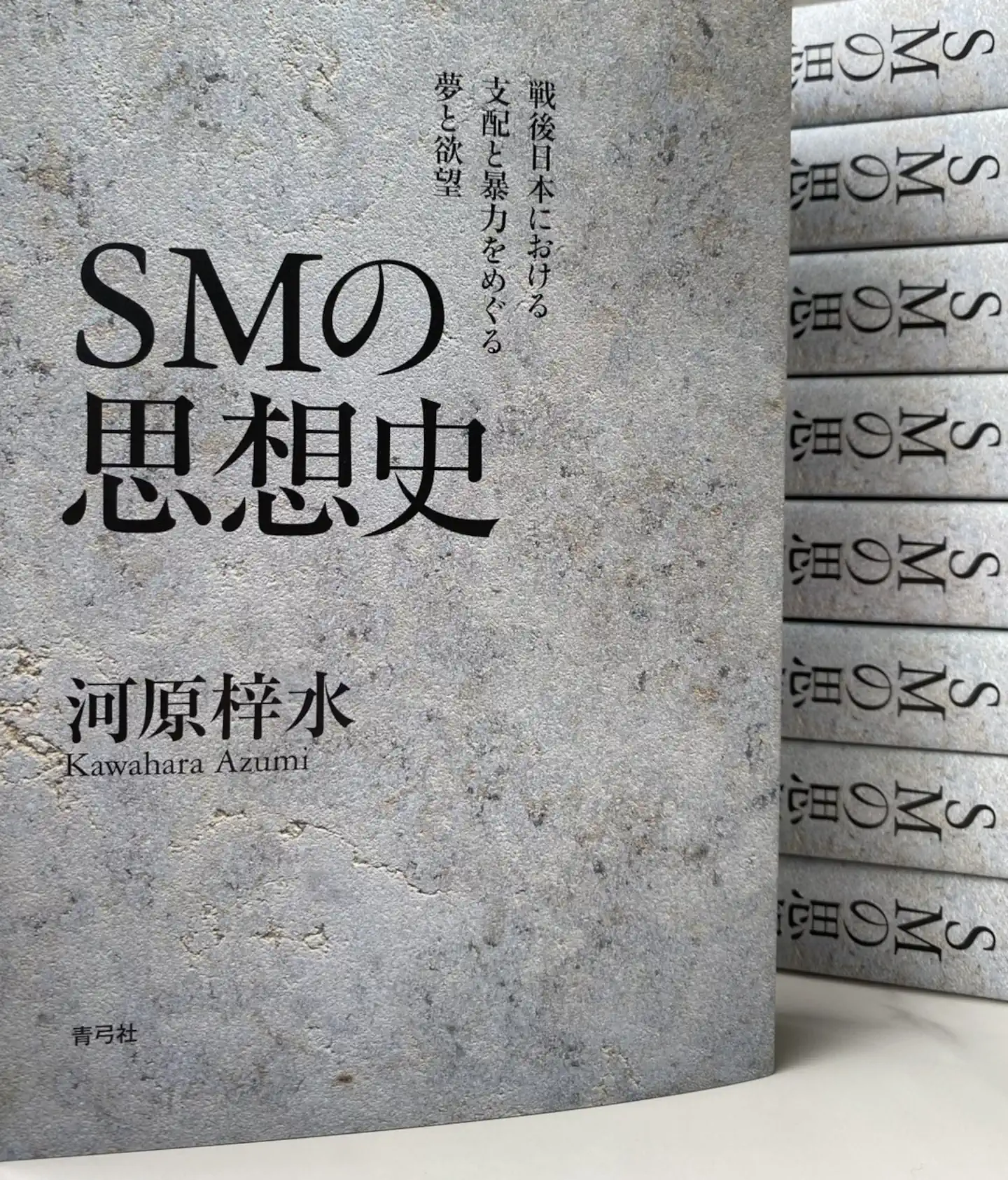
A book about domination, violence, and desire in postwar Japan
SM no shisōshi: Sengo Nihon ni okeru shihai to bōryoku o meguru yume to yokubō was published by Seikyūsha in May 2024.
The title translates as An Intellectual History of SM: Dreams and Desires around Domination and Violence in Postwar Japan. The framing is precise: the book doesn’t just tell a history of sexual practices. It reconstructs a field of thought organized around fantasies of domination, violence, submission, pleasure, consent, love, and modern life.
The book starts from an academic blind spot. For decades, materials like Kitan Club might be famous in fan circles or remembered as part of postwar cultural underground lore, but they hadn’t been studied as complex historical sources. Kawahara traces the genealogy of 1950s magazines, the links between titles, the authors who wrote for them, and the ways readers helped build a vocabulary for talking about desires deemed abnormal.
The book rests on three moves at once:
- Documentary recovery. Kawahara works through magazines, tables of contents, specific issues, reader sections, authors, pen names, and editorial context.
- Literary reading. Novels, confessions, and stories aren’t reduced to “data.” They’re read as texts, with strategies, genres, voices, and fictions.
- Intellectual history. Erotic materials are connected to debates about modernity, democracy, nationalism, marriage, autonomy, consent, and gender.
That triple move explains why the book landed as something singular. The innovation isn’t just daring to tackle a taboo object. It’s building the methods you need to study it properly.
Ayumi Mitsuishi’s review: an “exceptionally solid” investigation
Among the available reviews, one of the most significant is by Ayumi Mitsuishi, professor in the Faculty of Letters at Nara University and a specialist in modern Japanese literature. The review ran in Tosho Shimbun, no. 3658, October 5, 2024.
The review frames the book as an investigation of sadism and masochism through new research methods. That framing matters, because it shifts the conversation: it’s not just about adding a new object, but about recognizing that standard disciplinary methods can fall short with it.
Mitsuishi stresses that, until recently, it would have been hard to publish an academic book tackling sadism and masochism head-on — not for lack of material, but because academia tended to treat SM as a perverse hobby for a handful of dilettantes, not a problem worth researching.
The review recalls that Japanese literary studies did allow masochism in when it showed up in canonical authors like Tanizaki Jun’ichirō — but that permission depended on authorial prestige. Kawahara breaks that barrier by centering postwar SM culture magazines and authors.
The review highlights three main contributions.
First contribution: source-based magazine studies
The first contribution is systematic magazine research. Mitsuishi values that Kawahara doesn’t treat Kitan Club in isolation, but as part of a postwar constellation: Ningen Tankyū, Amatoria, Fūzoku Sōshi, Fūzoku Kagaku, and others. That move lets her map genealogies, differences in quality, imitation, and circuits of circulation.
That matters in two ways. First, magazines become objects of cultural history in their own right. Second, studying them demands real material archaeology: going through issues, comparing sections, dating changes, identifying authors, spotting pen names, reconstructing editorial networks, and watching how reading communities took shape.
The review notes that Japanese academic research had looked at kasutori magazines and middlebrow literature, but not always at the later fūzoku magazines. Kawahara helps fill that gap. The SM magazine stops being an eccentric outlier and joins the history of media, the history of reading, and the history of sexuality.
Second contribution: confessions, letters, and novels as literary texts
The second contribution is reading confessional pieces and novels through literary criticism. In Kitan Club’s editorial culture, “confession” is never simple. Many texts read heavily fictionalized even when presented as lived experience. At the same time, they functioned as porn, as self-exploration, as communication with other readers, and as affirmation of stigmatized desires.
Kawahara’s reading lets you understand these texts as discursive spaces. In them, people who recognized themselves in minority practices or desires could find a language. Confession wasn’t just exposure; it could also be a way to belong. A reader’s letter wasn’t just commentary; it could be an act of appearing in a scattered community.
That perspective is especially valuable for studying sexual minorities where institutional archives are thin. If official history didn’t preserve those lives, marginal magazines may hold decisive traces. But those traces have to be read without naïveté: fiction doesn’t cancel historical value; it transforms it.
Third contribution: postwar intellectual history through SM
The third contribution Mitsuishi flags is intellectual history. Here the book reaches furthest. Kawahara doesn’t present SM as a sexual curiosity. She uses it to analyze postwar Japan.
The case of Azuma Shin, for instance, lets you study a theory of sadism that aimed to de-pathologize it and tie it to equality between men and women.
The case of Numa Shōzō and Kachikujin Yapoo lets you trace nationalism, fantasies of subordination, and representations of the Japanese body in an extreme erotic imagination. The question isn’t whether these texts are morally acceptable. It’s what historical problems they condense.
That’s why An Intellectual History of SM is exactly the right title. SM doesn’t appear as something external to thought, but as a place where ideas about personhood, desire, violence, equality, love, and community get produced.
Public reception: from niche to the general press
Beyond Mitsuishi’s review, Kawahara’s profile records other forms of public reception for SM no shisōshi. It’s worth not overstating this: press coverage doesn’t replace scholarly assessment. But it does show the book broke out of a narrow specialist circuit into broader cultural conversation.
That shift matters. A book on postwar Japanese SM could easily have stayed confined to fan communities or sexuality-studies niches. Its pickup in newspapers and general-interest outlets suggests Kawahara framed the problem broadly enough to engage readers concerned with culture, literature, ideas, feminism, democracy, postwar memory, and free expression.
In other words: SM no shisōshi doesn’t just legitimize an object. It demonstrates that the object lets you re-read general questions in contemporary Japanese history.
The importance of not turning the book into “official history”
One risk with a book this influential is that it gets read as the last word. Kawahara’s work points the other way. Her method doesn’t aim to replace a community mythology with a single academic authority. It opens a way of working: widen the источников base, correct chronologies, read minor texts, cross-check testimony, recover archives, and live with the ambiguity of the materials.
In that sense, SM no shisōshi should be understood as foundational, not closing. If the book builds a field, it does so by showing that the field can only move forward with new research: on magazines still unstudied, unknown readers, hidden authorship, censorship, regional circulation, editorial economics, links with sex work, international translation, Western reception, and community memory.
The book’s strength is precisely that it doesn’t promise a clean history. It works with messy, mixed, fictionalized, fragmentary, often uncomfortable materials. That’s what the archive actually looks like.
Kawahara and kinbaku historiography: memory, lineage, and documentary criticism
The problem of received history
Kinbaku holds a particular place in the Western reception of Japanese SM culture.
In the West, its history has often circulated as an artistic tradition with masters, lineages, aesthetic genealogies, and a privileged relationship to “Japanese culture.” That narrative mattered for legitimizing kinbaku outside Japan: it let people present it not as mere porn or violence, but as art form, embodied practice, technique, performance, and cultural heritage.
That legitimization came with a historiographical price. Often the history circulating in the West was “a history about a history”: a narrative filtered through translations, memoirs, popular books, charismatic teachers, personal loyalties, and efforts to ennoble the object. The difficulty isn’t only language or access to Japanese sources, though both are decisive. The deeper problem is that the materials supporting kinbaku history aren’t homogeneous.
A 1953 magazine page, a memoir written in old age, an edited interview, a photograph published in a commercial magazine, a reader letter, an English translation, a self-published book, and an academic conference paper are not equivalent sources. All can be valuable, but they don’t say the same thing and shouldn’t be used the same way.
Kawahara’s contribution here is to help move kinbaku history from heroic genealogy toward a historiography of sources.
That doesn’t mean denying the importance of masters, technique, or oral transmission. It means situating them inside a larger ecosystem: SM magazines, editorial economics, censorship, commerce, photographic production, fantasy, sex work, reader correspondence, autobiographical memory, and international reception.
From kinbaku as art to kinbaku as part of SM culture
One necessary move is to stop treating kinbaku as an isolated object. In many Western narratives, kinbaku is lifted out of the SM culture that circulated it: rope gets foregrounded as aesthetic form, technical lineage gets emphasized, and the pornographic, commercial, or perverse contexts that shaped its modern history get pushed to the margins.
Kawahara helps correct that framing. Her research on magazines like Kitan Club shows rope was only one element in a broader SM culture, where fiction, illustration, confession, reader letters, legal debates, ads, photographs, pen names, editorial techniques, and forms of sociability all coexisted. Kinbaku doesn’t make proper sense cut off from that archive.
That shift has real consequences. If kinbaku is studied only as art, you tend to get a tidy history centered on masters and styles. If you study it inside postwar SM culture, less comfortable — but historically indispensable — elements come into view: sexual desire, commerce, censorship, fantasy, magazines, readers, image production, the adult video market, editorial labor, and practices that don’t always fit the art narrative.
The goal isn’t to drag kinbaku down. Quite the opposite: it’s to make it historically intelligible. A practice doesn’t gain rigor by being severed from its conditions of production; it gains rigor when those conditions are studied precisely.
Nureki Chimuo: indispensable witness, problematic source
Kawahara’s essay on Iida Toyokazu / Nureki Chimuo is an especially clear example of her method. Nureki Chimuo was a central figure in postwar Japanese SM culture: writer, editor, rope practitioner, bondage specialist, director of photographic and audiovisual productions, memoirist, and witness to the editorial history of magazines like Kitan Club and Uramado. Someone whose trajectory spans roughly sixty years, from 1950 to 2013, with work across writing, editing, and bondage image production.
Kawahara doesn’t downplay his importance. On the contrary, she recognizes Nureki as an indispensable source for studying both SM and media history. But precisely because his testimony matters, it has to be critiqued.
The essay’s methodological introduction is exemplary. The published interview isn’t a literal transcript; it was compiled into conversational form from tapes and notes, and the audio has been lost. That forces you to read the document as a mediated source. It isn’t Nureki’s “pure voice.” It’s a text produced through interviews, notes, editing, memory, and the loss of original material.
Kawahara also flags concrete errors in Iida/Nureki’s recollections or writings — some about dates, others about illustrators’ involvement or pen-name attributions.
The point isn’t to score points off a mistake. It’s to show that a protagonist’s memory can’t swallow the whole history. When a central figure becomes the main narrator of their own world, their recollections can circulate as fact. The historian’s job is to be grateful for the testimony and, at the same time, cross-check it.
That gesture is especially important in communities with informal transmission. Where complete archives are missing, witnesses acquire outsized authority. But that authority can produce simplified versions, involuntary silences, or retrospective hierarchies. Kawahara shows how to use those memories without getting captured by them.
Critique doesn’t destroy memory: it makes it usable
A hasty reading might take Kawahara’s critique as distrust of SM community members. That would be a mistake. Her work doesn’t disqualify memory; it makes memory historically usable.
Memory is necessary because it preserves dimensions the print archive doesn’t record: personal relationships, working conditions, editorial atmospheres, internal practices, forgotten names, motivations, conflicts, and everyday gestures. But memory also selects, omits, reorganizes, and justifies. Time produces errors; the narrator’s position produces emphases; loyalties produce silences; the desire to make sense of a life produces coherent narratives where there may have been contingency.
That’s why Kawahara doesn’t pit memory against archive as if one were false and the other true. She proposes a stratified reading: memoirs, magazines, interviews, letters, photographs, editorial records, and literary texts need to be cross-referenced. History emerges from that crossing, not from a single source.
In kinbaku’s case, this stance is especially valuable because it lets you step out of the devotion-versus-debunking trap. You don’t have to choose between believing the masters wholesale or tossing out their stories. You have to understand what kind of source each story is.
The Kyoto kinbaku symposium and the problem of authority
Available notes mention the symposium “New Wave Kinbaku X Asian Humanities,” held at Kyoto University in 2020, as an episode that opened debates about academic rigor, source authority, and the problematic use of popular or non-academic works.
Without reconstructing every detail of the controversy here, the historiographical point is clear: once kinbaku becomes an academic object, it can’t rely solely on legitimizing narratives produced by the scene itself or by its Western reception.
Books like The Beauty of Kinbaku may have played an important role in kinbaku’s international diffusion and in presenting it as art. But an influential book does not automatically become a primary source, nor sufficient historiographical authority.
The issue isn’t denying the cultural value of those books. It’s defining their status. A Western popular text, a practitioner memoir, a partial translation, or a synthesis aimed at non-Japanese audiences should be cited for what they are. If they’re used to reconstruct postwar Japanese history, they need to be cross-checked against magazines, archives, editorial chronologies, Japanese testimony, peer-reviewed research, and analysis of social context.
Kawahara thus appears as a figure introducing scholarly accountability into a field charged with affect. That move can feel uncomfortable, because many communities build identity around received genealogies. But without that discomfort, there is no critical history.
Kinbaku history as media history
One of Kawahara’s potentially greatest contributions to kinbaku studies is shifting it toward media history.
Modern kinbaku didn’t circulate only through direct teaching. It circulated through magazines, photographs, illustrations, stories, videos, ads, stage names, and editorial networks. That mediation changes how you write its history.
If the question is “who tied whom, and what technique was passed down?”, history will organize itself around masters and lineages. If the question is “how did certain images, desires, and practices become visible?”, then editors, photographers, writers, models, readers, printers, distributors, censors, and collectors come into view.
Kawahara forces a wider field of vision. Nureki Chimuo, for example, wasn’t just a nawashi, a bondage technician. He was also a writer, editor, producer, memoirist, and media worker. His importance isn’t reducible to technical skill; it includes his role in shaping the visual and textual imaginaries of Japanese SM.
That approach lets you write a more material history of kinbaku: not just bodies and rope, but paper, ink, cameras, publishing houses, pen names, translations, private archives, and secondhand markets.
The Western dimension: translation, legitimization, and loss of context
Western reception of kinbaku has been shaped by language barriers and access. Many practitioners outside Japan first encountered kinbaku history through translations, workshops, master books, blogs, and secondhand accounts. That produced a particular relationship to sources: in the absence of direct Japanese reading or access to original magazines, certain syntheses acquired outsized authority.
The problem isn’t that those syntheses are useless. The problem is that they often blend historical information, aesthetic interpretation, personal memory, a drive for legitimization, and community pedagogy. When that blend gets cited as history, you lose the ability to tell those layers apart.
Kawahara’s work is corrective because it puts kinbaku back into a broader postwar Japanese context. It isn’t enough to translate names or dates; you have to reconstruct the cultural ecosystem in which those practices circulated. That includes censorship, fūzoku magazines, transformations in pornography, obscenity debates, shifts in the publishing market, reader participation, and the relationship between minority desire and postwar democratic norms.
Western kinbaku history thus needs a double move: acknowledge what translations and teachers made possible, and critically revise the simplifications that process produced.
Against purified history
One consequence of Kawahara’s approach is a critique of purified kinbaku history.
Presenting kinbaku solely as art can help fight prejudice, but it can also hide essential dimensions: eroticism, perversion, commerce, fantasy, censorship, imagined violence, the desire for submission, and pornographic production.
That doesn’t mean reducing kinbaku to porn. It means accepting that its modern history can’t be separated from the erotic media that made it visible. A mature historiography doesn’t need to clean up its object in order to study it. It can hold beauty, technique, desire, market, symbolic violence, care, risk, consent, and fantasy at the same time.
That complexity is precisely what Kawahara brings to the field. Her work lets you think kinbaku not as an isolated aesthetic relic, but as part of a larger history of Japanese SM, where meanings are negotiated between practice, representation, community, commerce, and archive.
The Kitan Club Project: living archive, reader memory, and historiographical rescue
A call for contributions on the 80th anniversary
The Kitan Club memory-gathering project is one of the most compelling initiatives linked to Kawahara, because it shows her research isn’t limited to interpreting existing archives — it also helps create conditions for future archives.
In a post published on note.com on October 29, 2025, Kawahara announced a call for Kitan Club memories. The magazine, founded October 25, 1947, will turn 80 in October 2027. To mark the occasion, the call invites longtime readers to submit personal essays and reader letters about favorite works, authors, collaborations, exchanges with other readers, or any memories connected to the magazine.
See the footnote link for details on this call.
Those administrative details matter because they reveal a concrete conception of the archive. The invitation isn’t open to just anyone opining retrospectively about the magazine; it seeks situated memory from people who had material contact with physical issues.
The requirement of having read at least one physical issue builds in a relationship to the printed object: this isn’t abstract memory, but reading experience mediated by a real magazine.
Kitan Club as “alma mater” and historical source
The call includes a particularly telling line. Kawahara writes that Kitan Club is, at once, the “alma mater” of enthusiasts and a source of high historical value; she adds that, now that the people directly involved have passed away, everything is on the verge of being lost.
That sentence captures the project’s central tension. Kitan Club isn’t just an external academic object. For many readers it was a space of affective, sexual, aesthetic, or communal formation. But it isn’t only a private fan memory either. It’s a historical source. The magazine belongs to a history of media, sexuality, postwar life, censorship, minorities, and popular culture.
The phrase “alma mater” needs to be read carefully.
It doesn’t necessarily idealize the magazine; it points to its formative function. For readers who found vocabulary, images, stories, or interlocutors there, Kitan Club could work as an informal school of desire. That dimension rarely shows up in library catalogs or bibliographic indexes. Hence the importance of collecting reading memories.
From magazine collecting to a reception archive
So far, much of the work on Kitan Club has depended on locating, ordering, and analyzing issues. That work is indispensable. But a collection of magazines doesn’t exhaust a magazine’s history. How it was read matters too.
The memory project shifts the archive from production to reception. It asks what Kitan Club meant to its readers. Which authors they remembered. Which issues they kept. Which sections mattered to them. Whether they sent letters. Whether they connected with other readers. Whether the magazine let them name desires they couldn’t express elsewhere.
That turn is fundamental for a social history of sexuality. Readers aren’t passive consumers; they participate in making meaning. In magazines like Kitan Club, the line between reader, contributor, confessor, character, and author could be porous. Letters and contributions built textual community.
By gathering memories, Kawahara helps build a reception archive. That archive can open up new questions:
- How did reading experience vary by generation, gender, region, or personal trajectory?
- What role did magazines play in forming networks among enthusiasts?
- How was the magazine’s materiality remembered: covers, paper, illustrations, sections, ads?
- What was the relationship between private reading and public participation under a pen name?
- How were censorship, risk, shame, or arousal perceived?
- What differences were there between reading the magazine in the 1950s, 60s, 70s, or later as a collector’s object?
These questions show the project isn’t merely commemorative. It’s a historiographical intervention.
The urgency of rescue
The call stresses that many people connected to Kitan Club have already died. That brings a sense of rescue urgency. Archives of marginal sexual cultures tend to vanish for multiple reasons: family destruction after an owner’s death, shame, censorship, lack of institutional recognition, material decay, dispersal through secondhand markets, author anonymity, and the precariousness of publications considered minor.
Kawahara is working directly against that loss. Her project recognizes that history doesn’t preserve itself. It has to be actively gathered, described, contextualized, and made available for future research.
There’s an ethical dimension here, too. This isn’t about extracting testimony to feed curiosity. The call allows pen names, sets publication conditions, distinguishes essays from letters, plans a print edition for contributors, and sets content guidelines. In a sensitive field, these rules aren’t bureaucracy: they’re part of caring for the archive.
The reader as historical witness
One of the project’s greatest strengths is recognizing the reader as a historical witness.
In histories of kinbaku or SM, the spotlight usually falls on masters, writers, editors, models, or directors. But readers were the ones who circulated, preserved, interpreted, and kept the magazines alive.
The Kitan Club reader isn’t just a consumer. They may also be a collector, correspondent, contributor, imitator, critic, memory-keeper, and survivor of a vanished editorial world. Their memories can reveal what the texts don’t say on their own: how you got access to the magazine, how you hid it, shared or solitary reading, subjective impact, domestic censorship, informal circulation, epistolary relationships, and links between printed fantasy and lived practice.
Postwar Japanese SM history needs these kinds of sources because many experiences were never documented in official records. Reader memory can correct a bias toward big names. It allows a history from below, more attentive to reading practices and reception.
Methodological risks of reader testimony
The project also raises risks. Reader memories, like those of famous figures, aren’t transparent.
They can be shaped by nostalgia, shame, idealization, a desire to belong, chronological confusion, or later reconstruction. Moreover, respondents to the call will be a particular subset: people who are alive, willing to write, with access to the call, and motivated to participate. They won’t represent all Kitan Club readers.
Those limits don’t invalidate the project, though. They just require critical reading. Kawahara has already shown, in her work on Nureki, how to treat memory as a mediated source. The same caution should apply to reader memories: not as brute facts, but as accounts of reception.
The upside is that even when a memory gets dates wrong, it can still be valuable for studying affect, interpretation, and forms of identification. Factual error doesn’t erase a memory’s historical meaning; it just demands you distinguish what kind of information it provides.
Antitled as alternative scholarly infrastructure
The project also highlights the role of Antitled.
The journal appears as an editorial space capable of hosting research and materials that may not fit easily into conventional academic publishing. A platform like Antitled makes it possible to combine research, archive, debate, and community.
That’s especially relevant for marginal research objects, where traditional institutional channels can be slow, restrictive, or unreceptive.
Antitled thus functions as knowledge infrastructure. It isn’t just a container for texts, but a space where a field can be built: publishing articles, convening memories, hosting debates, preserving documents, and connecting researchers with reading communities.
How the Kitan Club project relates to kinbaku historiography
The Kitan Club memory project also has consequences for kinbaku history. If we accept that modern kinbaku circulated in part through SM magazines, then reader memories can help reconstruct its reception.
Which rope images were remembered? Which authors or photographers mattered to specific readers? How were the differences between illustration, fiction, and photography perceived? What was the relationship between reading about bondage and practicing it? What role did magazines play in shaping fantasies, techniques, or vocabularies? How did names like Nureki Chimuo circulate among readers?
These questions expand kinbaku history. It’s no longer just about reconstructing which master produced which style, but about understanding how particular representations were received, preserved, and taken up by dispersed communities.
In that sense, the Kitan Club call could become a key piece in a social history of kinbaku — not because every reader necessarily talked about rope, but because the magazine was part of the ecosystem where rope gained modern visibility.
A form of knowledge situated between academia and community
The project illustrates a general trait of Kawahara’s: her work sits between academia and community, without collapsing into either. She takes enthusiasts’ memories seriously, but doesn’t abandon criticism. She recognizes Kitan Club’s affective value, but frames it as a historical problem. She opens a public call, but sets documentary and editorial criteria.
That balance is hard. In sensitive fields, academia can feel extractive or moralizing; community can resist criticism for fear of stigmatization. Kawahara proposes a third way: study rigorously precisely because the object has been stigmatized, and listen to the community precisely because its memories aren’t sufficient on their own.
Why her work matters
Expanding the field of what is historically thinkable
Kawahara’s first contribution is expanding what can be thought historically. SM, masochism, sadism, erotic magazines, sexual confessions, and kinbaku stop being marginal curiosities and become objects capable of illuminating postwar Japanese history.
This isn’t provocation for its own sake. It’s asking why certain objects were pushed out of legitimate knowledge, and what gets lost when you don’t study them. If a society classifies certain desires as perverse, those desires can reveal as much about the society as about the people experiencing them.
Joining documentary history and literary reading
The second contribution is methodological. Kawahara combines documentary research with literary analysis. That’s indispensable for materials like Kitan Club, where the boundary between testimony, fiction, fantasy, and experience is unstable.
A historian who read these texts only as documents could fall into naïveté. A literary critic who read them only as fiction could miss their social dimension. Kawahara works at the intersection: the texts are literary and documentary, imaginary and historical, pornographic and discursive — all at once.
Placing SM inside the intellectual history of modernity
The third contribution is conceptual. By studying sadism and masochism as problems of thought, Kawahara connects marginal practices to central categories of modernity: autonomy, consent, equality, marriage, democracy, violence, and nationalism.
That lets you flip the question. It isn’t just why certain people desired domination or submission. It’s what limits the modern ideal of the autonomous subject revealed when it ran up against desires that didn’t fit its premises.
Bringing source criticism into kinbaku history
The fourth contribution is historiographical. In kinbaku, Kawahara helps distinguish memory, myth, primary source, testimony, translation, and popular synthesis. That distinction is essential for a mature history.
Criticism doesn’t shrink the field’s richness; it increases it. It lets you recognize that communities produce stories about themselves, and that those stories are both sources and objects of study.
Building archive for the future
The fifth contribution is archival. The Kitan Club memory project shows Kawahara isn’t only interpreting the past; she’s working to keep it from disappearing. In marginal sexual cultures, where documentary loss is constant, producing archive is a form of scholarly and ethical intervention.
Azumi Kawahara occupies a singular place in the study of postwar Japanese SM because she combines three operations rarely found together: scholarly legitimization of a marginal object, rigorous source criticism, and attention to the communities that produced and preserved those materials.
Her professional profile matters because it underwrites a methodological intervention. Kawahara doesn’t step into SM to turn it into spectacle, nor to normalize it without friction. She studies it as a field where deep tensions of Japanese modernity become visible.
SM no shisōshi is the most ambitious formulation of that project. Her reading of Kitan Club, sexual confessions, SM writers, and fantasies of domination and violence shows that marginal archives can contain first-order historical thinking. Ayumi Mitsuishi’s review gets it right in presenting the book as solid, source-based research — biographical and literary — with reach into postwar intellectual history.
In kinbaku, Kawahara offers a necessary warning: repeating genealogies, memoirs, or artistic legitimization narratives isn’t enough. You have to distinguish sources, cross-check testimony, acknowledge errors, contextualize magazines, and accept that rope belongs to a broader SM culture shaped by commerce, censorship, fantasy, desire, editing, and memory.
Finally, the Kitan Club memory-gathering project shows the constructive dimension of her work. It isn’t just about analyzing an existing archive, but about preventing memories, experiences, and data that can still be collected from vanishing. In doing so, Kawahara turns a long-stigmatized magazine into an object of social, intellectual, and media history.
The significance of her work, in short, isn’t only that she brought SM into academic space. It’s that she demonstrated that studying rigorously what a culture labeled “perverse,” “ridiculous,” or “worthless” lets you understand that culture’s own limits more clearly: its norms, its fantasies, its fears, and its ways of imagining human life.