Koden is a technique inspired by traditional methods for apprehending criminals—think capturing, subduing, and restraining.
But hold up—this class isn’t about martial arts or self-defense. It’s all about the erotic experience.
This technique is particularly intriguing for learning how to manage the body’s tension through rope.
It’s part of the Shoden Keito (初傳系統) family of techniques and is one of the simplest ways to control the body.
It’s a highly effective restraint, crafted with just a single rope, a hon musubi knot, and two hojo-style cuffs.
Quick Rundown of the Process
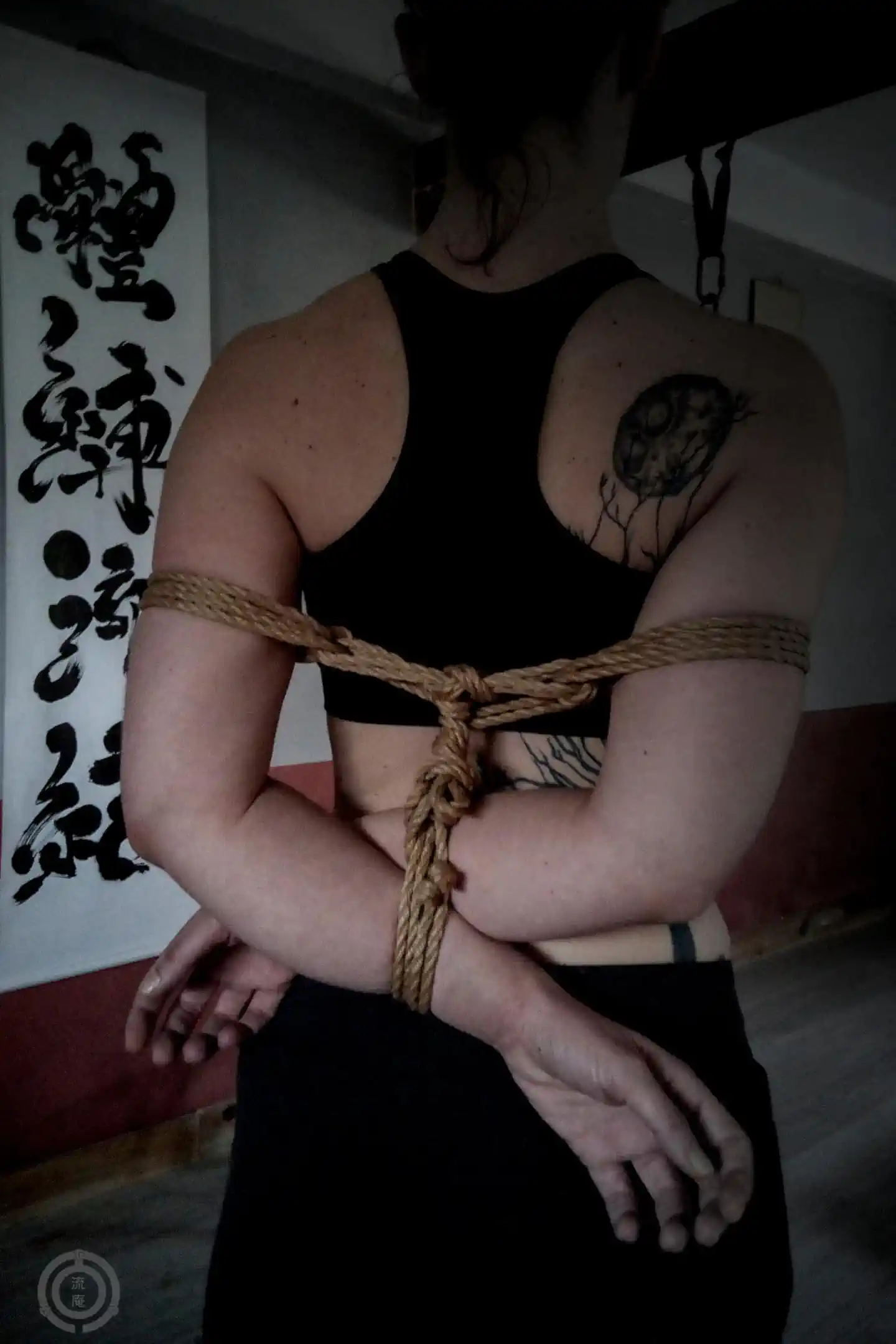
The construction works in a zigzag pattern: you start with one side, say an arm; move to the opposite forearm, then to the opposite shoulder; loop around the neck, and come back to the first arm to finish by securing the remaining forearm.
Visually, the result is striking—both for its simplicity and its strength, and for how it accentuates the tied person’s figure.
The standout feature is the hishi (菱) or diamond shape, a geometry loaded with symbolism in Japanese culture.
In Japanese culture, the diamond represents prosperity, good luck, growth, strength, and nobility.
For starters, we’ll use this form to focus on managing the body through rope, so both smooth rope handling and proper body activation are key to leveling up from here.
Rope Handling
To make this technique work, you need some rope skills.
This means: passing the rope over the body in the right direction, confidently, using the fascia to guide the tied person’s movements.
You’ll also need to master efficient frictions or locks.
A smooth application hinges on keeping the rope tension even at all times, and ramping it up when needed to match the body’s activation.
Jerks, tugs, or slack in the rope are a pain for the tied person, as their active muscles take the brunt of those jolts. Let’s avoid that.
A nice-to-have for the person tying is the ability to "feel" through the rope, picking up on subtle differences in the tied person’s body activation.
These are all skills we’ve covered in the course one way or another, but if you’re still unsure, we can dive into these in your next online class.
Either way, practicing this technique is a fantastic way to hone your skills and learn, since that’s the ultimate goal.
Body Activation
This form is a starting point for establishing a communication protocol between the tied body and the rope.
Here’s the deal: executing these forms will require the tied person’s body to move in ways that are likely brand-new or rarely used. So, the first step is teaching the body those movements.
To do this, we’ll start by recreating the shape without ropes, using the hands (of the person tying) so both can learn the motions.
Once that’s clear, we bring in the rope, and that’s when the tied person needs to respond with the right activation.
It’s not about tensing up when the rope touches you or fighting against it.
The rope should be a point of support, like an open hand in a dance: it leads, and you follow without resisting. No arm-wrestling or jumping the gun, since the other person is in charge.
The level of activation should match what’s happening at each moment. For most of this exercise, the tied person just needs to be present, teaching their body to first figure out the biomechanically optimal response and then execute it.
By definition, when a movement or sequence is new, your brain doesn’t yet have enough data to pull it off confidently.
That’s why we practice first—to build movement patterns that serve as a guide.
The clearer and more efficient these patterns are, the smoother their application in erotic play.
As the rope “connects” different parts of the body, the tied person needs to progressively manage their activation, engaging their muscles.
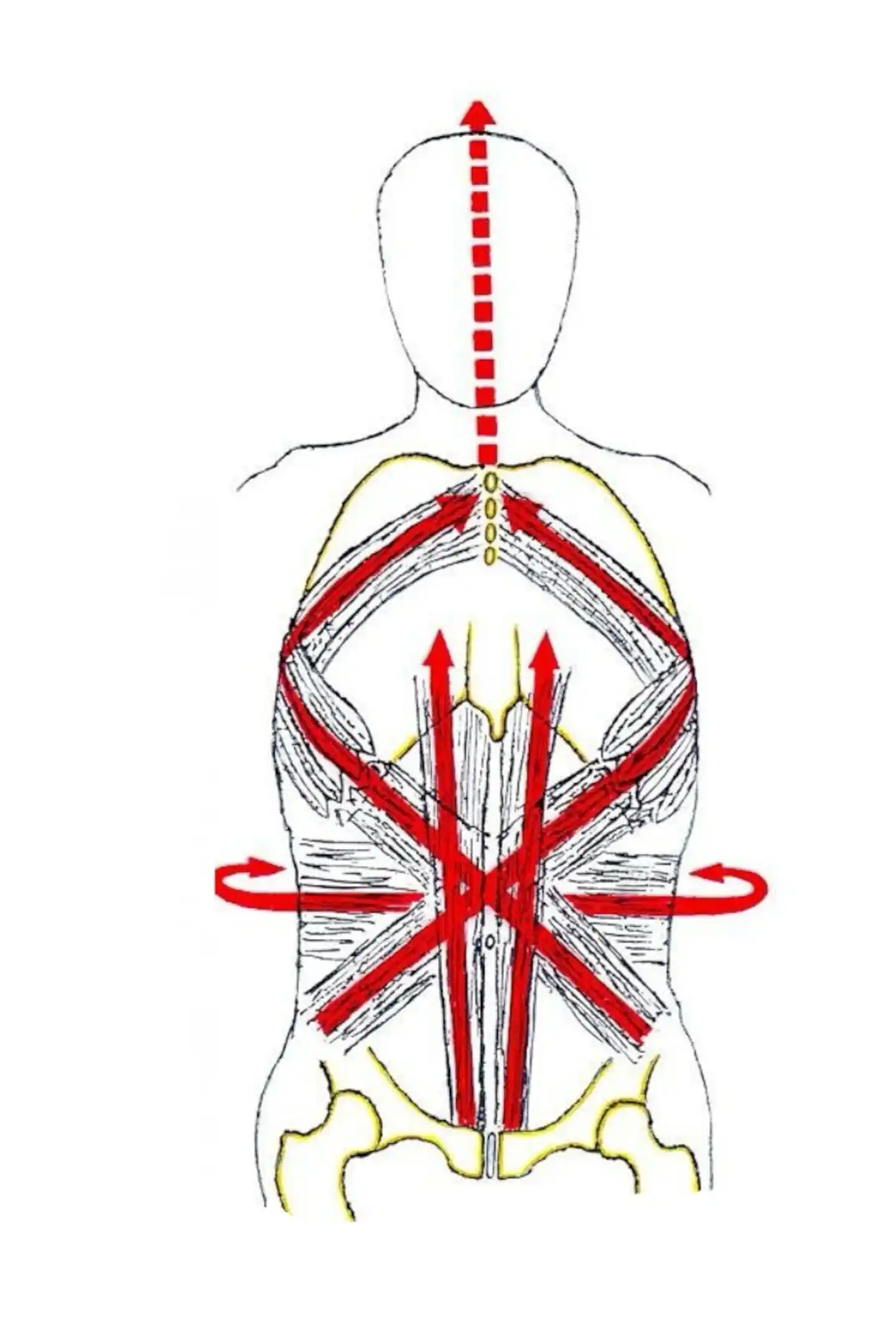
The muscle structure of the torso follows a zigzag pattern, which the ropes mimic. So, when the rope secures the left arm, for example, the response should flow through the muscles from the right hip, up to the shoulder, and then engage the arm against the rope.
Rather than “pushing against,” it’s better to say “leaning into,” like resting on the edge of a pool to climb out.
Naturally, the more body parts the rope controls, the greater the activation needed—both in scope and intensity.
That’s something to keep in mind, as in longer sessions, fatigue will creep in sooner rather than later.
This technique is particularly tiring for the tied person.
Vectors
Why is this form so exhausting for the tied person? Because the sum of the forces pulls downward more than upward.
The lower part of the tie—the two cuffs, one on each forearm, and their connection—pulls upward. But from there, everything pulls down: the arms, and especially the shoulders. With no line across the front to balance things out, the net force drags the body downward.
That’s one of the purposes of these forms. Remember, they were designed for restraining prisoners.
Meaning of the Name
Koden Shibari (古傳) can be translated as “old-school restraint,” reflecting the value of time-tested techniques and paying respect to tradition and those who came before us.
The inspiration for the form comes from ancient martial arts, particularly those that gave rise to what’s now popularly known as hojo-jutsu.
Heads-up: this form is an application created for erotic shibari. It’s not an “ancient martial arts technique.” Here, hojo-jutsu is an umbrella term for a body of knowledge from various sources and traditions.
Aesthetic
This form creates a stunning figure on the back of the body, with clean lines and a striking diamond or hishi (菱) in the center of the back. Over the course of a session, it can evolve into a stricter form, turning the diamond into two lines crossing at the center.
Symmetry vs. Adaptation
The “diamond” (hishi 菱) is both the aesthetic and functional hallmark of this form. In photos, it’s often shown as a perfect, mirror-image diamond.
Spoiler: that’s not the goal here.
A perfectly symmetrical tie won’t fit the body well, since humans aren’t symmetrical. One arm is always stronger, one shoulder rotates more than the other…
The key is adapting to the tied person. Never try to force someone to fit a shape drawn on paper.
Variations
Reminder: this is a technique, not a fixed figure.
Once you get the technique, you’ll know how to adapt and apply it wherever it makes sense.
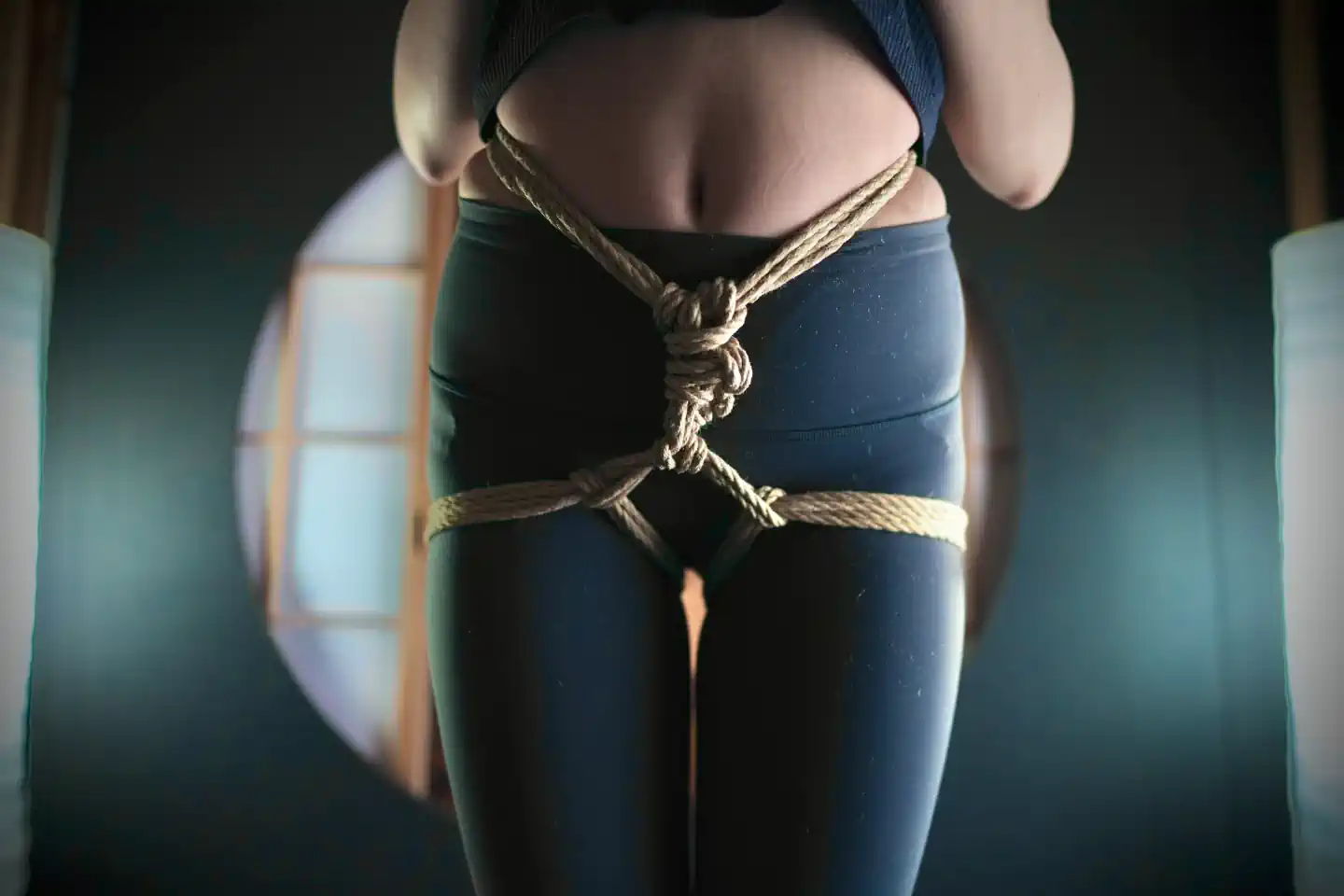
For example, there’s a variation used as a hip harness by Yagami Ren.